How Many Clicks Should a Zone Get Before You Blacklist It?
By Rinku TeamOct 23, 20268 min read
Anyone who has launched a pop or push campaign across a few hundred zones knows the moment when the first zones start eating budget without a single conversion, and the question that follows is always the same: is this zone bad, or has it simply not seen enough traffic to show what it can do? Cut it too early and you lose a placement that would have paid for the whole test. Cut it too late and you fund a zone that was never going to convert. In this article I look at how buyers answer that question in practice, why the popular rules of thumb are really a statistical test in disguise, and why the hardest part of zone testing is not sending a zone to the blacklist but knowing when to bring it back.
Why the Number of Test Clicks Matters
Every zone has a break-even conversion rate, which is simply your cost per click divided by the offer payout. On push traffic at $0.01 a click with a $3 payout, a zone needs to convert at 0.33% to pay for itself, which means one conversion every 300 clicks. That number is the bridge between the two ways buyers talk about testing, because the familiar rule "give each zone one payout of spend" is exactly 300 clicks here, and "three payouts" is 900.
What the rule of thumb hides is the probability behind it. If a zone converts at precisely break-even, the chance that it shows at least one conversion within a given test budget looks like this:
Test budget per zone
Clicks at $0.01 CPC, $3 payout
Chance a break-even zone converts
Chance you blacklist it by mistake
0.5x payout
150
39%
61%
1x payout
300
63%
37%
2x payout
600
86%
14%
3x payout
900
95%
5%
In other words, the multiple you pick decides how many good zones you are willing to lose. At one payout, more than a third of the zones that would have broken even get cut before their first conversion, while at three payouts it is one in twenty, but the test costs three times as much. On a campaign with 400 zones and a $3 payout, that is the difference between risking up to $1,200 and up to $3,600 on testing. A proper statistical answer would need around a hundred conversions per zone, which almost nobody can afford across hundreds of placements, and that is why buyers settled on payout multiples in the first place.
The unit also depends on the format. On popunder traffic a click is the opened window itself, so ad CTR tells you nothing and the early signal worth watching is the click-through rate of your prelander. On push, in-page and native, where people actually choose to click an ad, CTR is a meaningful signal before the first conversion arrives.
What Buyers Actually Do
When I went through our own interviews with buyers, public case studies and network guides, the methods turned out to be variations of the same idea with very different appetites for risk.
The staged approach is the most common among experienced buyers. One widely shared Zeropark setup pauses a target that has not converted within one payout, pauses it again if it has fewer than two conversions by two payouts, and cuts the bid by a quarter when ROI is below 25% after four payouts. In another test, the same author first split the traffic into separate campaigns by format and geo, pops and redirects for the US and for Australia, and only then applied the rule inside each slice, giving each source one and a half payouts and each individual target one before pausing it.
The aggressive approach works when volume is plentiful. In an iGaming follow-along with payouts of $45 to $60, the buyer paused sources at 55 to 70% of a payout and backed it with an observation worth remembering: the placements that were profitable after $100 of spend had almost all converted within the first $25, while those that converted for the first time after $25 to $30 lost money about three times out of four. In a McAfee push case on a $52 payout, the rule paused any target that spent $15 without a conversion in the previous three days. The flip side is the math from the table above: a rule that cuts at half a payout also sends more than half of the break-even zones to the blacklist, so the more aggressively you cut, the more you need a way to bring a zone back when its conversions arrive late.
The conservative approach is what networks themselves tend to recommend. PropellerAds suggests a test budget of two to three payouts per zone, and their representative on affLIFT advised adding one more payout on top of the test just to clear out bot-heavy placements. Some buyers skip money altogether and think in clicks, like the push buyer who described an automated rule that blacklists a zone at 100 clicks and zero conversions and shares that list across campaigns. And one of the buyers we interviewed for Rinku keeps it even simpler with a rule in his network account that stops any zone that spends $5 without converting.
Why the Rule Belongs in Automation, Including the Way Back
None of these methods works if it depends on the buyer being awake. A rule that runs every few minutes catches a zone that starts draining budget at three in the morning, which is why the buyer with the $5 rule described automatic stops as the thing that lets him sleep at night.
The weak spot of every rule is the late conversion. A deposit can arrive days after the click, and a lead in nutra can be confirmed a week or two later, so a zone that looked empty when the rule fired may turn out to be profitable once the postbacks land. One buyer told us about zones his team had blacklisted that turned out to be among the best performers when they reviewed the month, and another asked us directly for a system that rechecks blocked sources over a longer period and unblocks them on its own if the conversions show up after the ban. Even in public follow-alongs the pattern repeats: one buyer paused a campaign at about $30 with no conversions, saw the first conversion arrive almost two weeks later, and restarted it by hand.
So a rule worth trusting needs a few things beyond a spend threshold. It needs a minimum volume of clicks or spend so it never judges a zone on noise, a time window long enough to leave room for conversion delay, and attribution of late conversions to the day of the click rather than the day the postback arrived. It needs to judge the zone on the event you are actually paid for, so a deposit offer is not optimized on cheap registrations. And it needs a way back, so that a zone which starts converting after the block returns to the campaign instead of staying in the blacklist forever.
Most trackers stop well short of that. In Binom's public documentation, traffic source integrations are described as a way to start and pause campaigns in the network, and its API can return a ready-made blacklist from a saved filter that the buyer then uploads or scripts into the network. Keitaro's integrations with ad platforms are documented around pulling costs and sending conversions, and the automated blacklisting that people associate with it usually runs on the network side. Buyers who want zone-level automation with these trackers typically add a separate optimizer on top. Among SaaS trackers, Voluum's Automizer can pause and resume elements of a campaign through its rules.
How This Works in Rinku
Rinku was built around the idea that finding and stopping a losing zone should take minutes, so optimization rules evaluate traffic zone by zone and act on it directly.
A rule in Rinku starts with a minimum clicks threshold, 100 by default, so a zone is never judged before it has enough traffic to say something. On top of that you set one or more conditions that must all be true at once, using conversions, cost, CPA, profit, ROI, CR or bot rate, which means the classic "spent $10 and still has no conversion" rule is two lines, and a bot filter can catch a bad placement before the first conversion would ever have arrived. Each rule looks at a rolling window from one hour to thirty days, applies to all campaigns, selected campaigns or every campaign of one traffic source, and can notify you in the app, by email or in Telegram, either for each zone the moment it triggers or as a digest every 15, 30 or 60 minutes.
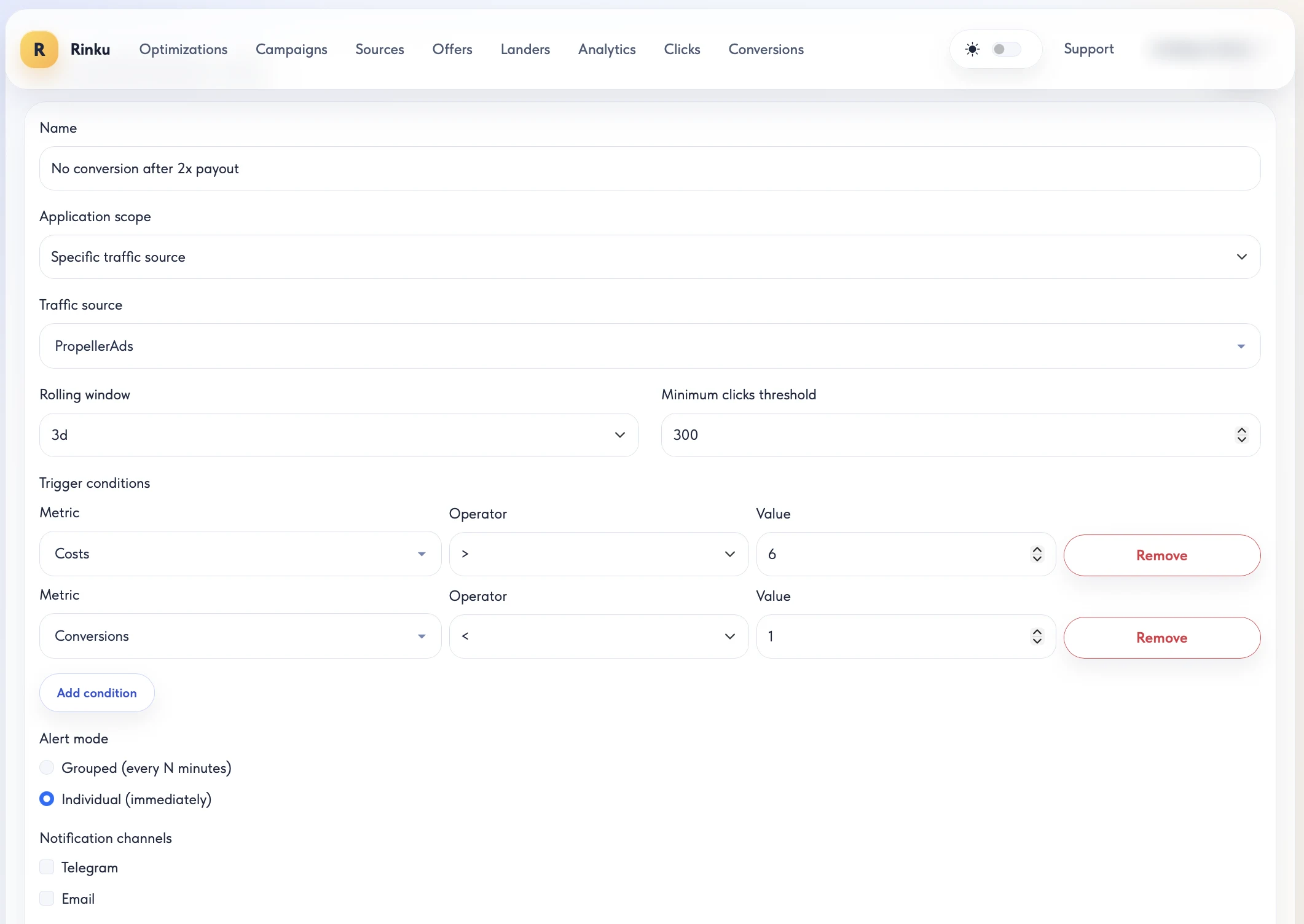
A rule that flags a zone after two payouts of spend without a conversion, with a three-day window for late postbacks.
Rules work on the conversion event you choose as the one that counts for the offer, so on a gambling offer that pays for deposits the rule judges zones on deposit economics rather than on registrations. Late events are attributed to the day of the original click, so a deposit that lands three days later is credited to the zone that sent it.
For sources connected through the network's API, which today covers Adsterra, ExoClick, Galaksion, HilltopAds, PropellerAds, RichAds and TrafficStars, Rinku can block zones automatically as soon as a rule fires, and if the network's API returns an error, you get an alert that the automatic block failed so the zone does not quietly keep spending. The same integration handles the way back. Analytics shows how many conversions a zone brought after it was blocked, and if those conversions push its revenue above the rule's conditions, Rinku returns the zone to the campaign through the API and it starts receiving traffic again. For sources without an integration, the rules and alerts work the same way, and you add or remove the zone in the network yourself.
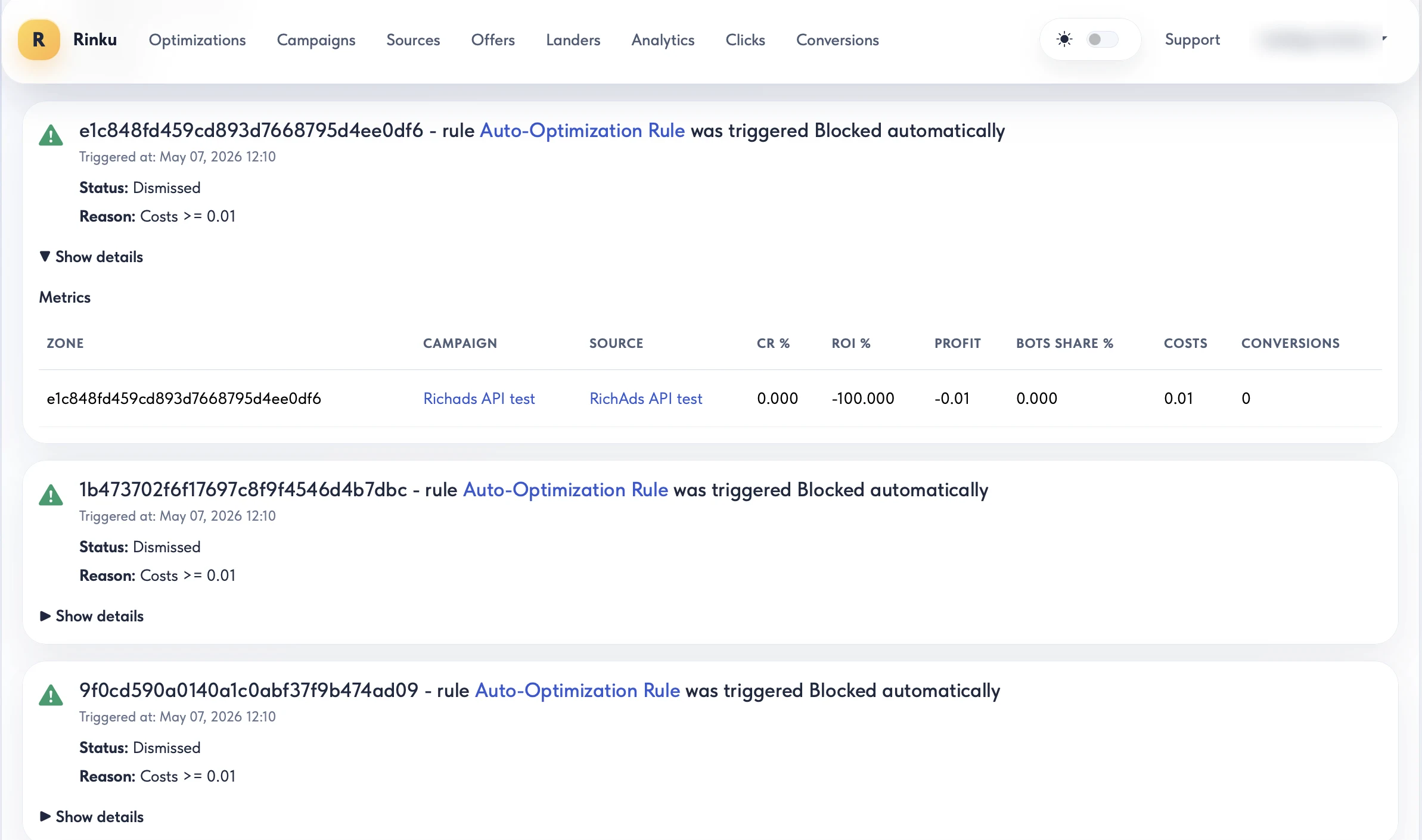
Alerts for zones that a rule blocked automatically through the network's API, with the metrics behind each decision.
There is no universal number of clicks a zone deserves, because it depends on your payout, your format and how much volume you can afford to lose. What you can control is that the number you choose is applied the same way on every zone, every hour, and that a zone you cut on incomplete data gets its chance back when the data catches up.
Rinku is an ad tracker for media buyers who want to find losing zones fast and scale the ones that pay.
Automatic zone blocking and recovery through network APIs are part of the Expert plan, and you can try them at rinku.cc during the 14-day free trial.