Auto-Optimization: Catching a Bad Zone Before It Catches You
By Rinku TeamSep 24, 20266 min read
Every media buyer has lived through the same morning. You open your dashboard after a night of running traffic and find a few zones that spent all night burning through budget without a single conversion to show for it, while the rest of the campaign looked perfectly healthy in the aggregate numbers you glanced at before going to bed. And while you were sleeping, those specific placements weren't watched closely enough to catch them in time, and by the time you did, the money was already gone.
What the Problem Actually Costs
A single bad zone rarely looks dramatic while it's happening. It's a placement pulling in clicks at a normal rate, at a normal price, blending into a campaign total that still looks fine on the surface. The damage only becomes visible once you drill down, and by then several hours or an entire overnight run have usually already passed.
Put a number on it and the problem stops being abstract. A zone spending $50 an hour with zero conversions for six hours overnight is $300 gone on traffic that never had a real chance to pay back, and that's a single zone on a single night. Run several campaigns across several networks at once, and the accumulated leakage from zones nobody caught in time becomes a meaningful share of monthly spend, quietly eating into a margin that would otherwise be healthy.
The frustrating part is that this is a timing problem which can be solved if a media buyer was present and monitored stats without missing anything, like a robot. This is not realistic for a human to do.
How Tracking Platforms Generically Help
Manual monitoring has been the default for years, and it works up to the volume where a person can actually pull the stats and go zone by zone every morning: update costs, check overnight performance, cut whatever crossed an obvious line, repeat the next day. It breaks down with scale, since a buyer managing hundreds of zones across several networks is checking in cycles measured in hours rather than minutes, and a zone burning cash between checks burns it the whole time uninterrupted. A good tracking platform closes that gap by giving a buyer resolution first, so "the campaign looks okay" becomes "eleven zones look okay and one is actively losing money," and then by letting the buyer encode the judgment call itself: a rule holds the threshold, evaluated on a rolling window with a minimum click sample so a temporary dip or a run of unlucky clicks doesn't get mistaken for a trend, and the more complete platforms connect that flag straight to an action, an API call that pulls the zone out of rotation, so the gap between noticing a problem and fixing it collapses from however long it takes a person to notice to however long the rule takes to evaluate.
What's Available in Rinku for This
Rinku's optimization feature was built directly from conversations with media buyers describing exactly this problem, the gap between catching a bad zone and stopping it. It works as a full loop rather than a single alert, and every stage of that loop maps to a specific piece of the buyer's actual workflow.
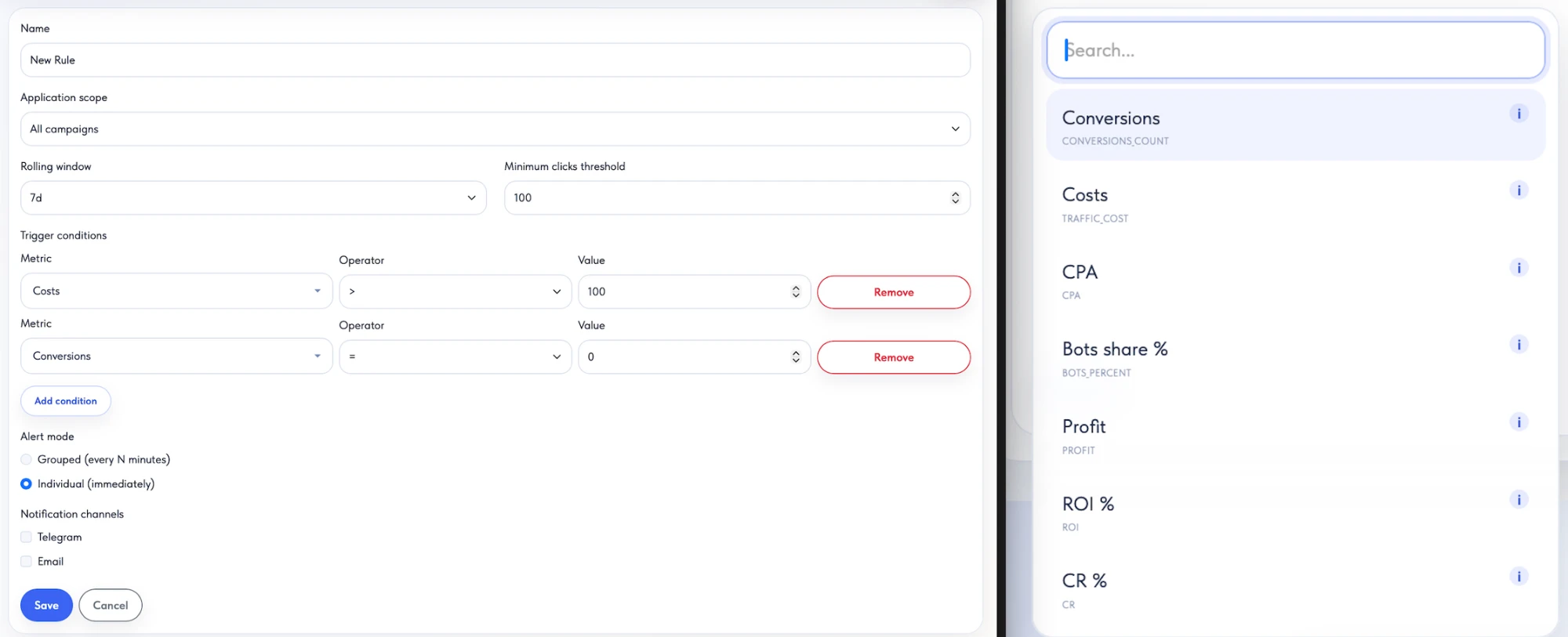
At the center is a rule engine that evaluates traffic by zone. A rule is defined against a rolling time window, a minimum click threshold before it's allowed to act, and a set of conditions that can combine multiple metrics at once, cost, conversions, CPA, ROI, profit, bot rate. That combination is what keeps a rule honest. A rule set to fire only when ROI drops below negative twenty percent and cost exceeds a dollar amount and clicks exceed a minimum sample won't misfire on a slow first hour, but it will catch a zone that's genuinely bleeding money by the time the numbers are real.
Rule settings and metric variety
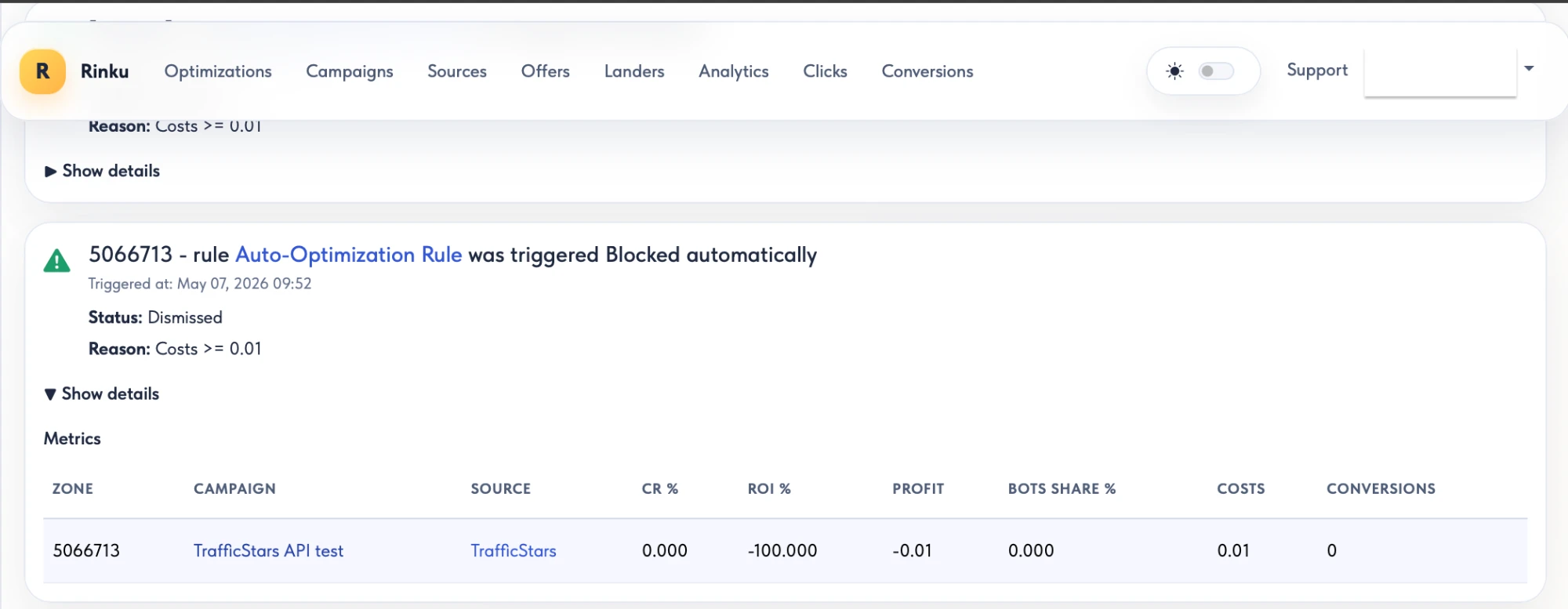
When a zone crosses those thresholds, Rinku creates an alert that carries a full snapshot of the metrics that triggered it, so the reasoning behind every block is preserved and checkable later rather than something the buyer has to reconstruct from memory. That alert can notify through the app, Telegram, or email depending on how closely the buyer wants to watch, and it's visible directly inside the analytics view without having to leave the report to check a separate alerts screen.
For traffic sources Rinku integrates with directly, Adsterra, ExoClick, Galaksion, HilltopAds, PropellerAds, RichAds, and TrafficStars, that alert can trigger an automatic block through the network's own API, and the zone comes out of rotation without the buyer having to touch anything. That automation sits behind a safety gate at the campaign level, so a rule firing doesn't mean live traffic gets blocked unless the buyer has specifically turned auto-optimization on for that campaign, which matters during testing or when rolling the feature out gradually across a portfolio rather than trusting it everywhere at once.
Notification example
For a source that isn't on that integrated list, the detection and alerting still work exactly the same way. The only difference is the final step, blocking the zone in the network, happens manually instead of through an API call, and the buyer confirms it back in Rinku once it's done. That's a meaningful distinction, because it means the intelligence behind the feature isn't locked to a handful of supported networks. A buyer running traffic through a source Rinku hasn't built an integration for yet still gets the same rule-based detection and the same evidence trail, just with one manual step at the end instead of zero.
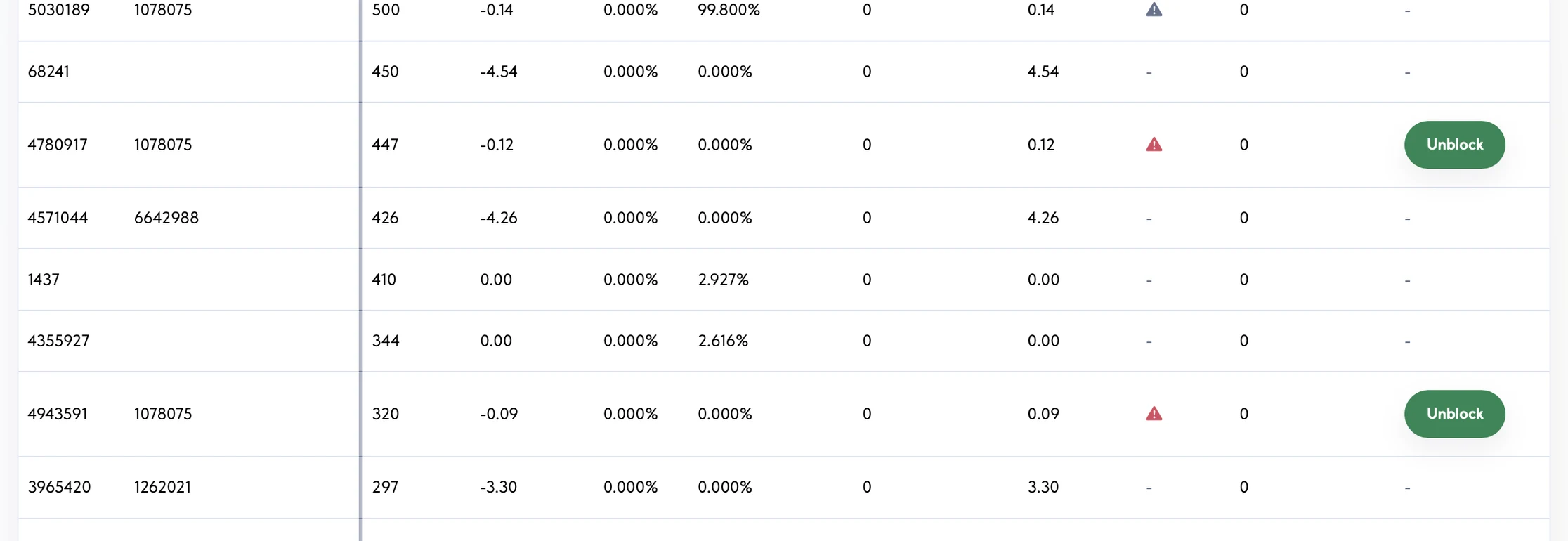
The system also accounts for the case where a rule fires on incomplete data. Conversions sometimes arrive later than the traffic they belong to, particularly on offers with longer approval windows, so a zone that looked dead at the moment of the block can look very different a day later. Rinku tracks conversions that come in after a zone was blocked, which gives the buyer a way to catch a false positive and re-open a zone that was actually fine, rather than leaving good traffic permanently cut off because of a timing quirk in how conversions were reported.
Check our full documentation on how the auto-optimisation functional works - Rinku Docs
What This Actually Changes
None of this replaces judgment. A buyer still decides what the thresholds should be, still reviews what got flagged, still decides which campaigns are trusted enough to let a rule act without a human in the loop first. What changes is where that judgment gets applied. Instead of spending the first twenty minutes of every morning manually sweeping every zone across every campaign looking for what bled overnight, that sweep already happened while the buyer was asleep, and what's left to review is a short list of zones with the exact numbers that got them flagged attached.
That's the actual value of the feature, not automation as an abstract good, but the specific difference between a bad zone getting caught at 3 a.m. and a bad zone getting caught the next time someone happens to look.
Rinku is a campaign tracker built for media buyers who need to find losing traffic fast and stop it before it drains a budget.